Round table discussions on the use of artificial intelligence in higher education have been successfully conducted across six European countries within the EHEAII project. The discussions took place between January and March 2026 and involved 70 experts representing academia, university management, industry, and student organisations .
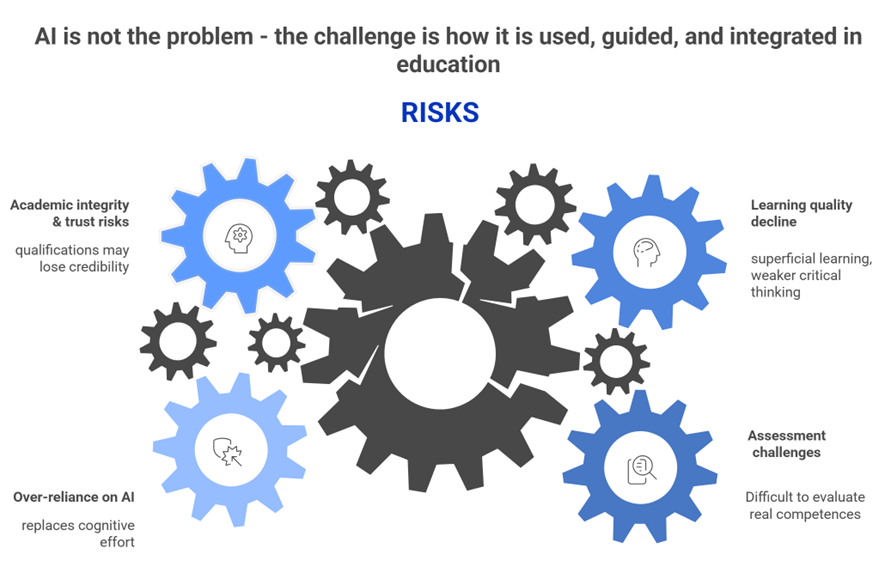
The newly published report highlights that AI is already deeply embedded in everyday academic practices, primarily as a support tool for information search, content structuring, idea generation, and assessment development. However, its use remains largely unstructured and uneven, with students often adopting AI more actively than educators.
The discussions reveal a growing gap between technology use and actual competence development – students are increasingly able to complete tasks using AI without engaging in deeper analysis or critical thinking. This raises concerns about learning quality and the ability to assess real competences. At the same time, AI is gradually replacing traditional information search practices, with both students and educators relying directly on generative tools.
Another key insight is the transformation of teaching roles. Educators are expected to move from knowledge providers to facilitators, mentors, and learning designers, focusing more on guiding students, fostering critical thinking, and designing meaningful learning experiences. This shift is closely linked to the need to redesign assessment methods, moving towards process-based, problem-solving, and reflective approaches.
The report also highlights that current policies and guidelines are still at an early stage and often lack practical applicability. There is a clear need for flexible, continuously updated frameworks, as well as stronger institutional support and training for educators.
A central conclusion is clear – AI is not the problem; the challenge lies in how it is used, guided, and integrated into the educational process. In addition to the overall report, national round table reports from each participating country are also available, offering more detailed insights into country-specific contexts and practices.
In addition to the overall summary report, country-specific reports are available from Latvia, Lithuania, Germany, Italy, Spain, and Slovenia, providing more detailed insights into national contexts and experiences.
Reports are available HERE.