Artificial intelligence is no longer a future concept in higher education – it is already a daily working tool for a significant share of academic staff.
The results of the international survey conducted within the EHEAII project provide an overview of how artificial intelligence is currently integrated into higher education from the perspective of academic staff.
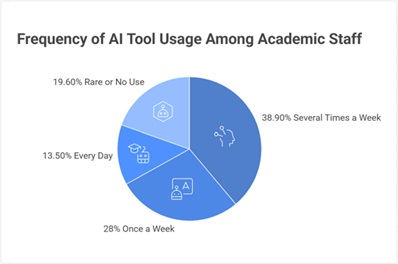
The survey gathered 453 responses from educators and researchers representing 61 higher education institutions across more than 20 countries, ensuring a diverse and representative insight into current practices and experiences. The findings reveal that AI is already widely embedded in academic work, with a significant proportion of respondents using AI tools on a regular basis – including weekly and even daily use.
One of the key findings highlights that academic staff generally demonstrate a moderate to high level of familiarity with AI tools, although advanced expertise is not yet widespread. At the same time, AI is primarily used for practical and efficiency-driven tasks. The most common applications include translation, preparation of teaching materials, writing support, and presentation development, confirming that AI is mainly supporting content creation and communication processes.
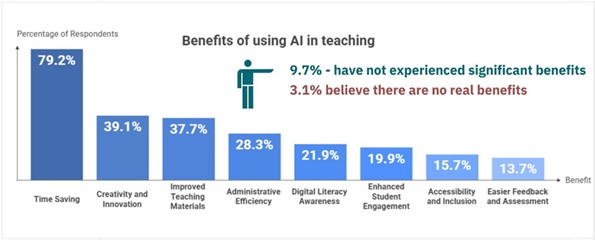
Respondents clearly recognise the benefits of AI, with time-saving identified as the most significant advantage. Additional benefits include improved quality of teaching materials, increased efficiency in administrative tasks, and support for creativity and innovation. At the same time, the results highlight that AI contributes to raising digital and AI literacy among academic staff and can enhance student engagement and accessibility.
Alongside these benefits, the survey identifies substantial concerns and risks. The most prominent issues relate to the potential loss of critical thinking skills, academic dishonesty, over-reliance on AI tools, and the spread of inaccurate or biased information. A majority of respondents report having already encountered cases of AI misuse by students, particularly involving the submission of AI-generated work without proper understanding or disclosure. These findings underline growing challenges related to academic integrity and learning quality.
Another important insight relates to institutional readiness. While many institutions have started developing policies and guidelines on AI use, these are often perceived as unclear or insufficiently communicated. Training opportunities and institutional support are also uneven, with many educators indicating a need for clearer guidance, practical training, and access to reliable AI tools.
Looking ahead, respondents strongly expect AI to significantly transform teaching practices in the near future.
The full Survey Report provides a detailed analysis of these findings, including data on AI usage patterns, tools, benefits, risks, and institutional readiness.